Newborn photography is an art—but it’s also a responsibility. Ensuring baby safety while ALSO protecting your own body is key to a long, successful career. But when it comes to caring for our own bodies, how can we actually fit that into our busy photographer lives?
Well, Jamie Noyes, a photographer with a background in physical therapy, is here with her best tips for caring for ourselves while we care for our infant clients.

In this episode, Jamie and I talk through baby safety and proper infant posing, how to build connections with clients during sessions, and the common mistakes she sees photographers making that can lead to injuries. Plus, she’s breaking down simple stretches and habits photographers can use to relieve pain that might already be bothering you.
What’s in this episode:
- [01:51] Jamie’s unique history in physical therapy and how it’s influenced her photography career
- [07:40] The safety concerns around certain photography poses for babies
- [12:37] What photographers can do to prevent common injuries and pain from their profession
- [18:09] Stretches and exercises that photographers can use to relieve pain from common injuries
- [21:38] Small habits that photographers can incorporate to take care of their bodies
- [25:08] A little pep talk for photographers that are doubting themselves or their abilities
- [29:47] Jamie’s lightning round
If you’ve been interested in body mechanics (both for yourself and your clients), this episode with Jamie is one you can’t miss!
SUBSCRIBE: Apple Podcasts | Spotify
Resources Mentioned
Meet Jamie Noyes
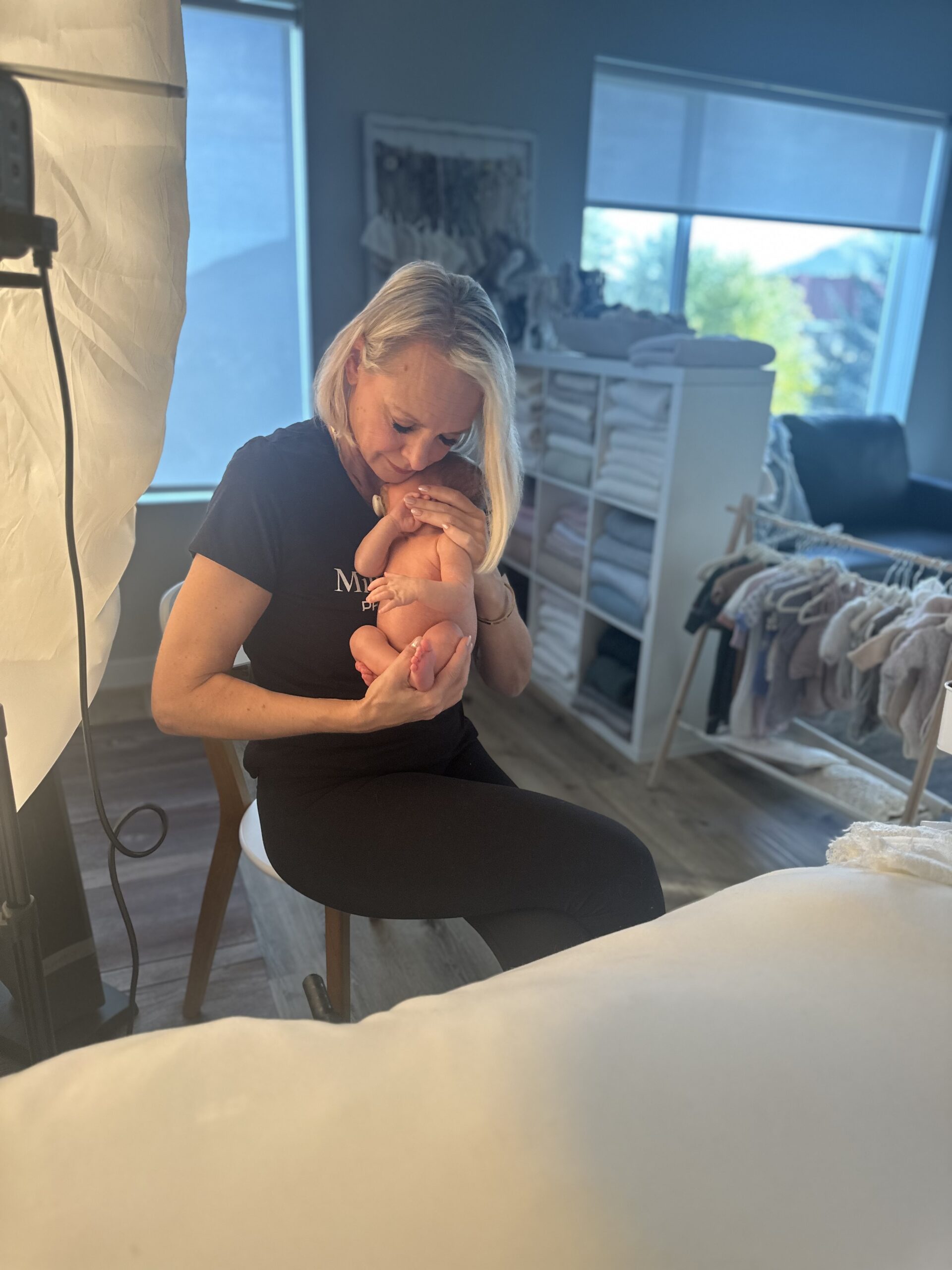
Jamie is a maternity, newborn, and child photographer in Central Michigan, with some family sessions in the mix as well. She was a Physical Therapist Assistant for 15 years, gaining valuable knowledge that she now incorporates into her photography business. She has also become a personal trainer, and getting back into teaching people correct posture, stretching, and strengthening allows her to stay connected to the world of therapy. Both jobs are incredibly rewarding to her.
Connect with Jamie
Did this episode with Jamie make you rethink how you use your body as a photographer? Check out this episode Play, Prompts, and Passion: How Liz Devinny Creates Playful Photography Masterpieces that shares how another photographer started their career!
Transcript
[00:00:00] Jamie: I have the dad come help. Dads have strong hands, and that’s their baby. They don’t want nothing to happen to their baby, so they want to hang on to that baby. They want that picture, and they get really excited about it, and I really love having dads come in and be part of it sometimes, because it makes it special for them.
[00:00:17] You know, their wife just did this, however many hours worth of work to have this baby, and now he gets to have a moment of his own little, like, you know, hey, look it, I helped make that picture.
[00:00:32] Lisa: Hey friend, welcome to the art and soul show. I’m your host, Lisa DiGeso, a mom, a photographer and entrepreneur. Tune in here for pep talks, conversations, and advice on photography, creativity, mindset, business, life, and that messy in between. This is the place where you can go when you need a boost of encouragement, a kick in the pants and inspiration to pick up your camera.
[00:00:54] This is the art and soul show. Hello, my beautiful friends. Welcome back [00:01:00] to the show today. I am very excited to have a conversation with Jamie Noyes. Jamie is a talented maternity, newborn and child photographer based in central Michigan. Now, before diving into photography, she spent 15 years as a physical therapist assistant, which gave her a deep understanding of movement.
[00:01:18] Posture and body mechanics, something she now weaves into her photography work. On top of that, she’s also a personal trainer and loves helping people with proper posture, stretching and strengthening, which brings her back to the therapy roots in such a rewarding way. Now, I can’t wait for you to hear her insights.
[00:01:35] So let’s dive in. Welcome Jamie. Hi. Now, can you share who you are and what you’re super passionate about?
[00:01:43] Jamie: I’m Jamie Noyes, and I have been a photographer for almost 14 years now. My passion is creating beautiful art for my clients, um, whether it’s maternity, newborn children. I do some families, usually I try to do those mostly [00:02:00] outside in evenings, in our evening beautiful light that we have in the summer here in Michigan.
[00:02:06] My other passion has always been helping people and getting stronger. Rehabbing them, I done PTA work for 15 years, like you had said, and it was mostly post surgeries, you know, shoulders, uh, hips, knees, but I also did a lot of therapy with little kids and babies, um, with developmental delay or, you know, some sort of a genetic disorder from birth.
[00:02:32] I also worked with a lot of pre and postnatal clients. So I did a lot of pool therapy and so that was a lot of fun, um, learning. And now I use a lot of that in my work. A lot of people don’t. probably think about me using something in the medical field in what I do with a camera, but it’s a lot like you said with the posture and I feel like I’m constantly [00:03:00] analyzing people now, their posture, and then just like babies.
[00:03:05] And just watching them develop, like if I have a baby planner for newborn six, nine, 12 months, I’m constantly like, Oh, can they sit at this age? Can they crawl? Can they stand, you know? And so it’s kind of fun to watch kids grow and see how, um, some kids. Some kids are a little behind sometimes, which is totally normal, and some kids are like nine months old and they’re running.
[00:03:27] Lisa: I know. I’ve had, I’ve had some sessions where I’ve had nine months old and I’m like, Oh my gosh, your baby’s walking. Like what is happening here?
[00:03:33] Jamie: Yeah. So at nine months, I’m always like, Oh, they’re going to be running at the one year at their kick smashing. I don’t know what I’m going to do. We’re going to angle them.
[00:03:41] I always tease them and I have to duct tape them down.
[00:03:44] Lisa: I love that. So how do you find your background in physical therapy really influenced your approach to photographing newborns in your maternity clients?
[00:03:53] Jamie: It gave me the confidence. Yeah. To be able to take someone’s brand new baby [00:04:00] and know that every time I’m moving them and positioning them.
[00:04:05] I know I’m doing it safely, and I know I’m not going to hurt them. And I can pay attention to their little noises. I mean, we all have heard babies make those noises, but sometimes those noises are different and can be a little alarming in their breathing. A lot of times we really want to pay attention to a baby’s breathing, especially when we’re wrapping them up really nice and snug.
[00:04:28] We want to make sure we’re not making those wraps too tight on their neck and chest and airway. In their hands, you know, sometimes we put our hands like this with those wraps. We just want to make sure it’s not under their airway. Yeah. And also, a lot of new moms don’t realize that Babies can be born with a broken collarbone.
[00:04:46] Yes. Through the birthing canal. Yes. And uh, I shouldn’t say just new moms. I mean, anybody. Yeah, most people don’t know that. And so with that, when you bring a baby to me, I know that there are specific poses we cannot [00:05:00] do with a broken collarbone because it will further injure the baby. And we don’t want that.
[00:05:05] I’ve had a baby come to me post surgical after a heart surgery. They’ve had an open heart surgery four days after they were born. And so they have this big incision in their chest. And so I had done wound care as well as a PTA. And so making sure that that wound is staying safe and clean and not getting fuzzies and, you know, whatever else in it.
[00:05:25] I had a baby come and she had had an incision in her lung. After she was born and um, I had to really make sure that that was safe and clean and you know Making sure that nothing was bothering that. I’ve had babies come with NG tubes. I’ve had babies come with oxygen tubes Sometimes I’ve I’ve had babies that have to be fed with just a tiny little like tube in their mouth because they’re having trouble eating And so for me, this does not bother me All these tubes and these these broken bones and the [00:06:00] incisions and stuff.
[00:06:00] It doesn’t bother me. And so I know that I’m safe with those babies and I know I can keep those babies safe because of my past and I’m so so grateful and thankful that I do have that past so that parents can just come and be like, here you go. You know what you’re doing. We don’t even, we don’t even have to worry about this.
[00:06:20] We know that you’ve had the background and that you’re safe and that we’ve heard these things about you and this is why we chose you. And so, I did. I don’t know if I can say this or not, but I did have a baby, um, choke a month ago. Oh my gosh. And so I keep up to date on my CPR and first aid. And now we know babies can’t choke on an object, but he was choking and he kind, he did stop breathing for a second.
[00:06:43] So I just scooped him up and I flipped him over and I gave him very gentle pats. So kind of like, I’m like, but it was very, very gentle about it. And actually dad’s a doctor and mom’s going to school to be a doctor. So. Wow. And he had some like curdled milk that kind of flew out of his nose and his [00:07:00] mouth.
[00:07:00] And as soon as he passed that, wiped him off, I put him on my, um, lap, on his belly, and I just rubbed his back real gentle, and he was totally fine. And I just moved on with the session, and he never once panicked, I never showed concern. I just flipped him over and just kind of rubbed his back a little bit, passed whatever was hanging up in his little throat, and he was totally fine.
[00:07:23] So it’s things like that that I have to I guess pat myself on the back that I really pay attention to those things and in their breathing and in all those things. I’m so on high alert during those sessions.
[00:07:33] Lisa: Yeah, that’s so important. Now, there’s been two poses that are quite controversial in our industry, and I’d love to hear your take on them.
[00:07:39] It’s the froggy pose, and it’s It’s the potato pose where babies like just sitting in a bowl all to themselves like this. And so there’s been studies done that I have read that they’re not advised because of restricted airway, what it does to joints and everything. So what is your take on that?
[00:07:56] Jamie: Well, as far as the potato pose, I mean, our babies are packed so [00:08:00] tightly in our bellies and we don’t know exactly how they’re positioned in our bellies because every baby’s different and every mom’s body is going to hold the baby differently.
[00:08:07] So, as far as the potato pose, I feel like it is safe. I feel like, as long as it’s done safely, it’s just like any other thing we do in our photography world. As long as it’s done safely. And there again, it also goes back to what I had just said about Making sure that their breathing is safe. Yeah. And so, you know, you want to make sure that their arms are more across their chest than up here.
[00:08:36] Yeah. Pressing on their neck.
[00:08:37] Lisa: Rested in something here.
[00:08:39] Jamie: Yes. There are certain, sometimes I’ve had to re wrap two or three times a baby just because the baby, maybe they have a stiff joint or they’re really fussing and fighting one arm and they just don’t want that arm to be Brought in and swaddled in and so I really have to sometimes just bring their elbows [00:09:00] down to their side and I don’t usually necessarily always worry about the hands right away, you know, you get that base wrap in and then then you can kind of keep working on the next wrap and just making sure that their hands then can come out.
[00:09:14] I don’t find it to be such a super unsafe pose personally. These babies have been squished in bellies for nine months. So again, it’s just awareness and making sure those hands are not pushing on that neck right there. That’s the biggest thing. I love it. Um, as far as the froggy pose again, it’s not a natural pose.
[00:09:35] We’ll just say that like it’s just not natural. Whereas I feel like the potato pose a little bit more natural, you know, they’re just kind of balled up. But the froggy pose, I feel like, um, that definitely can be because people don’t realize that it’s. two pictures made into one or three pictures made into one.
[00:09:51] Terrifying. And so to me I think that’s a huge thing that people really need to be educated on. I do it on occasion. Babies just don’t really [00:10:00] sleep anymore like they used to. Right. Ten, twelve years ago. I know. You could put a baby naked and no, no diaper. You could do anything you want with the babies and they would just saw logs through the whole entire thing.
[00:10:10] Babies are a lot more touchy now and you wake up a lot easier for whatever reason. So to do the froggy pose with their hands like this, again, you got to make sure that their hands are not pushed back on that neck and that they’re more forward. Right along the jawbone. Yes, and also, I mean their backside, you got to make sure that the backside and their legs are underneath them.
[00:10:33] in that frog pose and not like one leg kicked out and all wonky. But it’s definitely something that you have to have an extra set of hands. I don’t work with an assistant. That’s just how I work. I have been trained, and I tell people this all the time, I was trained in my PTA schooling to catch people.
[00:10:54] So I’ve caught people for 15 years if they go to fall. I am so close [00:11:00] to those babies and my hands are always just right there. I’ve never, ever. Dropped a baby, injured a baby. I mean, I am so careful and if I have to step away, I ask dad to come over. Hey dad, can you come sit here and just, and I make him put his hands, like.
[00:11:17] Not on the baby, but right there. Right there. And then if I do, do happen to do the froggy pose, I have the dad come help. Dads have strong hands. And so, and that’s their baby. They don’t want nothing to happen to their baby. So they want to hang on to that baby. They want that picture and they get really excited about it.
[00:11:36] And I really love having dads come in and be part of it sometimes because it makes it special for them. You know, their wife just did this. However many hours worth of work to have this baby and now he gets to have a moment of his own little like, you know Hey, look at I have to make it. I have to make that picture.
[00:11:54] So again, it’s it’s just that airway We need to make sure that our our hands and [00:12:00] everything is just posed just right so that we’re not pushing an
[00:12:02] Lisa: airway And you can really tell in a session when you’ve got a baby that has It’s the first step of the process. And it’s one of those things that I always teach my students is that not all people’s would do all poses.
[00:12:16] And that is okay. We adapt our sessions for the baby. Right? So important. Now, many photographers really struggle with body mechanics during long sessions. As we get older, I’m in my mid to late forties. I’m getting a sore back. So what are some big mistakes photographers are making that could lead to injury with their own posture?
[00:12:38] Jamie: The biggest one, and I know I’m going to probably get flack for this, is that you’re not exercising.
[00:12:45] Lisa: Girl.
[00:12:46] Jamie: You’re not taking care of yourself. You’re not stretching. You’re not exercising. You’re not keeping yourself. Strong. I work out five to six days a week. I am up at 5 a. m. I am at the [00:13:00] gym at 6 a. m. I do 45 minutes to an hour of Exercise and it’s right now.
[00:13:06] I just go to classes and then if I have training clients Sometimes if they’re in a good position, I’ll work out with them, but you have to get up every morning before your session Take 15 minutes and stretch. Some really good things to do to keep your back safe is to work on core strength, because our core is our foundation of our body, and will help us stay strong, help us move without pain, and prevent us from having low back pain.
[00:13:37] Yeah. So if we are doing tabletop poses, We want to make sure that that table is at a comfortable position for us. Now, we’re all different shapes and sizes. It’s just like, you want to bring that, it’s like a workstation. Um, some people, I used to do workstation evaluations when I worked at the hospital.
[00:13:56] You want to make sure that your workstation is at a [00:14:00] level to where you’re not like this, working with a baby, or where you’re reaching really, really far and you’re really stressed on that low back. And making sure you have a stable stool. To sit on, and now I forget who it was, maybe it was Annabria? She used to sit on an exercise ball.
[00:14:18] Um, to do? Nope, I think it was her. And I couldn’t do that. No. Safety wise, that freaks me out. Yeah. But it does work your core. So I will tell you, sitting on an exercise ball while you’re editing for all those hours, doing it for 30 minutes, sitting back in your chair, it works your core. Because you can’t slouch, you can’t fall over, you can’t hunch when you’re on an exercise ball.
[00:14:41] You have to have a nice ball posture, which also engages your core, which strengthens your core. Now when we’re doing things like on a dog bed or trampoline, whatever people choose to use, you want to be down on the ground. You, you want to be on your knees. You don’t want to stand and bend. At your [00:15:00] waist, because you are going to pull muscle, you are going to injure yourself.
[00:15:05] And if you are someone who doesn’t exercise, or doesn’t do those stretches before a session, you’re gonna get hurt. And it’s just It’s just, it’s like if you don’t wear your seatbelt, you’re going to get into an accident and you’re going to get hurt. So, and plus it’s just good overall safety for us as we grow and as we age.
[00:15:24] And that was one of the reasons why I wanted to do this is because I’ve seen so many posts over the years. It’s like my
[00:15:30] Lisa: back, my back, my back. My wrist, my back.
[00:15:33] Jamie: I’m getting older, my back’s hurting, what do you guys do? And so if I go on and comment, well you need to go into an exercise and stretch, and everyone just like boo’s me, and I’m like, uh huh.
[00:15:42] But it’s not just for, for your job. Yeah. It’s for yourself. But it’s also for your family. Staying healthy, strong, and active is also not just for you, but for your family, too.
[00:15:54] Lisa: And even lifting weights for bone density, like, especially with women as we age, it is so important.
[00:15:59] Jamie: Very much [00:16:00] so. If I can give two pieces of huge advice for all women, you want to do strengthening and stretching.
[00:16:10] I don’t care. You don’t have to go run five miles a day. I don’t want you to do that. It’s actually not great for you. Yeah, so if you can just work in some strengthening and stretching, stretching every day, strengthening two to three times a week, you’re gonna prevent yourself from having back injuries or any other kind of injuries.
[00:16:30] And you’re also going to make your bones strong so that we won’t, hopefully, have osteoporosis as we age. My mother has osteoporosis. Terrible. It’s due to many different health concerns and issues that she’s had but she tried to put her bra on one day and she broke a rib. So if this doesn’t show you what osteoporosis can do to us as we age, I don’t know what does.
[00:16:56] Yeah, and it’s simple strengthening [00:17:00] exercises. You don’t have to be long to a gym. You don’t have to go to a gym. A few dumbbells. Yeah, and some YouTube videos if that’s what you want. There’s so many people posting on TikTok and on Facebook Reels and Instagram Reels about two second videos. Yeah. Do this, you know?
[00:17:18] Do that. Just working like on your core in a plank.
[00:17:21] Lisa: Mm hmm. And if you can’t do it There’s a new thing I just saw. Oh, it’s a Pilates board. Have you seen these? They’re really cool. And it’s just like this board where you like I don’t know. I don’t know. I’m a gadget girl. I love a gadget.
[00:17:34] Jamie: I know. I get it. But that’s I guess that’s like my biggest thing about this whole interview today is Stretching and strengthening.
[00:17:44] I love that. And if you all just took 20 minutes before your session, not even 20, how about 10? Can you, can you take 10 minutes out of your day before your session just to do some stretching? [00:18:00] It might help you.
[00:18:01] Lisa: Oh yeah, absolutely. I love that. I mean, our studios are so warm. It’s like literally like a hot yoga studio anyway.
[00:18:07] Exactly. So throw down your yoga mat and like do a few. Sun salutations and some dog and 10 minutes. 10 minutes. Yeah. I love that. That’s my challenge for myself, actually. I’m gonna do it. Good. I love that. I love it. So if a photographer is already dealing with wrist and back pain, are there any exercises or any stretches you would recommend to help that?
[00:18:30] Jamie: Yeah, so I know that if I have been. extra extra busy with shooting, my wrist will hurt from holding that camera and we constantly are doing this and our cameras can get really heavy and if we’re shooting a lot throughout the day, plus then we go and edit. So we’re constantly repetitively hurting our wrist.
[00:18:47] Some really great stretches is just pressing your palms together. And you can kind of feel that, and then you can just straighten your arm 90 degrees, and you can just press on the back of your hand, and then you [00:19:00] can do it the opposite way. Feels good. Yeah, so back in the 80s, when we, side note, back in the 80s, we used to always bounce our stretches.
[00:19:10] So for those of us that are from the 80s. 80s babies, yep. Don’t bounce your stretches. You want a static hold then for like 20 seconds. And then switch to the next stroke. And the other very good I think Sorry, Tindra. What about the stretch ball, like those um, balls?
[00:19:27] Lisa: All those stress
[00:19:27] Jamie: balls. Those are really great.
[00:19:29] Um, they’re good for more like, um, like a strengthening too, you know. But the stretches are gonna be more beneficial for those times where our hands and wrists are overused. Right. A couple more stretches that I really, really recommend, especially for our low back, is just hamstring stretches. So you can sit on your butt on the floor and just reach forward for your toes.
[00:19:52] Spread your legs. Reach forward to one side. Reach forward to the other side, standing up, reaching down [00:20:00] towards your toes, putting your heel up on a step or a stool or a couch, um, and reaching for those toes. And you also want to do quad stretches. So standing and grabbing, you know, the back of your ankle and, and keeping that knee pointing straight down to the ground and, um, working and pulling.
[00:20:19] You’ll, you’ll feel that quad stretch. If you’re tight, you’re going to feel it. They’re just. Those are two of the most important stretches that we can do. We also have one that’s called a mobility stretch and, or the child’s prayer stretch. So both of those are really good. And most people know what the child’s prayer stretch is.
[00:20:35] The mobility stretch is where you’re up on your feet and your booty is like down between your feet. So it’s kind of like a really low squat, and it just depends on how low you can go obviously. But both are really really great for a low back and that is usually what most of us are dealing with it by the end of a session is our low back is sore.
[00:20:55] So doing all those before your session and then doing even the [00:21:00] child’s Prayer pose or that mobility stretch after the session should help alleviate some of that pain or stiffness that you’re having in your back. Love it. What about like cat cow? Yes, those are amazing, especially if you are pre or post pregnant and because we do have a lot of people in our field that do this before they’re pregnant while they’re pregnant and after they’re pregnant.
[00:21:23] So cat cow is an excellent, excellent way to stretch out that low back and it’s so simple.
[00:21:30] Lisa: I love that. So, in addition to daily exercise, are there any other small daily habits photographers might want to adopt to stay strong and pain free?
[00:21:39] Jamie: Mmm. Drink a lot of water. Yeah. I know that doesn’t necessarily Not wine.
[00:21:44] Lisa: Not coffee. I know. I mean
[00:21:46] Jamie: Little bit of that. Right. You can have your glass of wine at the end of the day as a reward. Or having a great photo session. Yeah. I mean, one glass. Right? We gotta have a reward somewhere. Yeah. [00:22:00] But drinking tons of water. I mean, you need, you need the water. Your body, your muscles are, are, are, every fiber of our body needs water to grow and to stay protected.
[00:22:09] Yeah. So I know that that’s not necessarily stretching or um, strengthening, but water is our key.
[00:22:16] Lisa: Yeah. I love that. Now have you ever experienced an injury or maybe even just burnout from photography and if so, how did you overcome it?
[00:22:25] Jamie: Well, I didn’t get injured during a photo shoot. I pulled a hamstring muscle last May.
[00:22:34] Um, I was being a show off the mom. Mom show off and I was trying to do a cartwheel. Oh my gosh. And I’m like, oh, I work out every day. It’s not a big deal. And I had actually started working on doing handstands. It was a goal of mine to be able to do handstands without the wall and just be able to do it.
[00:22:54] So I went to do the, the kickover with your. with your cartwheel and [00:23:00] pulled my right hamstring. Terrible. So I limped and limped and limped for weeks.
[00:23:06] Lisa: That is a pain. I’ve done that myself. I drank three glasses of wine and said, Oh, I can do the splits like I used to do the splits. I cannot do the splits.
[00:23:14] I’m 45. I cannot do the splits. Same. I injured myself very much. Oh, no.
[00:23:20] Jamie: Try that. Yes. So, and it was really upsetting to me because I had just Made a personal goal for myself, and I had hit 360 pound leg press. Oh, you’re like injured. I injured myself like literally the same week. I was so, so mad at myself.
[00:23:38] So getting up and down off the floor with a newborn with an injured hamstring was quite interesting. Yeah, and I just warned everybody. I am having trouble getting off the floor. I hurt myself. I am fine. Your baby’s safe. I just
[00:23:54] Lisa: need you,
[00:23:54] Jamie: need you to grab her. So, yeah, it’s, I have not, [00:24:00] I don’t think I’ve ever injured myself during a photo shoot, thankfully.
[00:24:05] Lisa: I actually got caught in my camera strap while I was standing on something I should not have been standing on and I landed on the floor on my elbow. Yeah. Did you chip a bone or anything? It felt like I might have. I think everything’s fine now. This was probably about ten years ago. Oh, wow. I’m a natural klutz.
[00:24:24] Like, that is my superpower. If there’s a wall, I will walk into it. If there’s a doorknob, I will catch my clothes on it. I just, it’s a, it’s a superpower. It’s fine.
[00:24:34] Jamie: That’s hilarious. I mean, it wasn’t funny at the time,
[00:24:39] Lisa: but Yeah, in hindsight, it also just showed me, like, being more mindful of what I’m doing, and how I’m placing my body, and being aware of, if I’m injured, like, the whole team goes down.
[00:24:51] Yes. Right? Yes. Yeah.
[00:24:53] Jamie: I
[00:24:54] Lisa: understand. So many photographers really struggle with their confidence [00:25:00] in their work. So what advice do you have maybe for someone who might be doubting their abilities or just really struggling with that?
[00:25:08] Jamie: I know I, I still struggle, you know, after all these things and I think we all do.
[00:25:12] I think the best thing for me has been taking a class. Um, we’re joining one of the Milky Way retreats. I just joined this year’s retreat because there are a few things in there that I was like, you know, I really want to learn a little bit more about that or maybe I could change how I’m doing something to make my images look different or better or whatever.
[00:25:35] And I think that is a huge, huge confidence boost because we doubt our abilities. Because I think we get stuck. And we get stuck in a rut. Especially here in Michigan, and probably in Canada. Yeah. It’s winter, like we’re under a winter weather advisory right now. Oh yeah. We are getting like 9 inches of snow by like tomorrow morning or something.
[00:25:58] Which is crazy. [00:26:00] If, if we can just watch. Someone else work and then we can take that and practice in our own studio for a day I did it last week. I watched one of the videos on newborn positioning overhead and I nailed a picture on Monday That I am so proud of, and just like, whatever it was, and I have been to multiple in person classes.
[00:26:28] Yep. And I have done, I don’t know, three or four Milky Ways now. Yep. Plus multiple other like, classes and courses that I’ve joined over the years, because I’m a course person.
[00:26:39] Lisa: Oh yeah, me too.
[00:26:40] Jamie: That’s why my tweets exist. I even gonna lie, I have one that I’ve paid for. I don’t even know how to get into it. I don’t even know where to go to get into it.
[00:26:48] Yeah. And I’m embarrassed to even ask the person. I know. But when we’re seeking a boost in our confidence, we don’t go ask our spouse. [00:27:00] We don’t go ask our best friend. We don’t go ask our mamas. We have to kind of look inside of ourselves. And try something different. And sometimes that something different, it’s like, Oh my god!
[00:27:13] I got it! Look at that! It’s so different from last week’s newborn, just because I did one little thing different that I learned in watching this one video. So, I think that’s a really big thing. And with my PTA degree, we had to have continuing education classes. It was a must in order for us to keep our license and to keep us Yeah.
[00:27:33] Working. And so I’ve always continued to do that same thing in this job. And some people find, why spend the money? That’s ridiculous. Just watch something on YouTube. And that’s fine. And I’m not dissing that, but sometimes that nitty gritty. Down to earth one on one or watching these videos like you guys do if there’s something totally different about it And I think it’s really important for us because we always need to [00:28:00] keep learning I have been to so many different in person workshops with different photographers over the years and Some people may ask like why do you pay to do that?
[00:28:10] You already know what you’re doing No, there’s always going to be one little thing that you’re going to learn in that class or you’re going to connect with somebody in that class and then they’re your friend forever. You can then go back and forth with that photographer and say, Hey, what did I do wrong here?
[00:28:28] Hey, can you help me with this? Hey, I need an idea for this and they’re going to do the same thing to you. And so that just creates even a stronger relationship and it builds your confidence in the end too.
[00:28:39] Lisa: I love that. I am a full believer. I still take like almost a workshop every year and it’s something that’s important to me.
[00:28:46] The retreats literally exist because I’m a lifetime learner and I’m like, okay, who’s doing something interesting and different and what do we want to learn? Agree. Like, right? And then I just. People just say yes, it’s awesome.
[00:28:57] Jamie: You know, it’s like one thing or [00:29:00] someone might just try and they just kept trying and trying and try it and now they’re like known for that one thing.
[00:29:05] Exactly. And so now they’re like, I want to show everyone, I want to teach everyone how to do this one thing. And so then we all learn from it and then we all just because we’ve watched somebody and we’ve learned from someone’s Video or whatever, it doesn’t mean it’s always going to be exactly the same.
[00:29:21] No. We’re always going to have our own tweak. We’re always going to have our own style. And that’s what makes photography so unique, is that we all have our own style of doing things and our own little lighting and our own little poses and, and, and learning. You have to be a lifelong learner,
[00:29:37] Lisa: period. Yeah.
[00:29:38] I love that. I love that. I totally agree. All right. So are you ready for our lightning round? Yes. Okay. What is your go to comfort food?
[00:29:47] Jamie: Tacos. Mmm,
[00:29:48] Lisa: yes. If you could time travel, where would you go, past or future?
[00:29:54] Jamie: Future. Future. Yeah.
[00:29:58] Lisa: Dogs or cats?
[00:29:59] Jamie: Dots. [00:30:00]
[00:30:01] Lisa: One thing you can’t live without on a session day.
[00:30:06] Jamie: Breakfast. Nice. I have a friend who says, did you have your three breakfasts today? Like a hobbit. Because I have breakfast before I go to the gym, which is something little. I come home from the gym, I have a little bit more, and then I eat, because I always do my sessions at 10, and then I usually eat something again right before the session.
[00:30:26] Lisa: Yeah, I love it. I love it. Gotta fill your body. What is your hidden talent? Gosh, I wrote this down, but I don’t remember what I said. Hidden talent.
[00:30:38] Jamie: I don’t know, making people laugh, maybe.
[00:30:41] Lisa: I can, I’ve got a flat spot that’s so flat on my head that I can balance a drink on it. That’s amazing. I love
[00:30:48] Jamie: that.
[00:30:49] Lisa: Yeah, just have a flat head.
[00:30:51] If you weren’t a photographer or a trainer, what would you be doing?
[00:30:55] Jamie: I would be a pool girl in some tropical area for the rest of my [00:31:00] life, serving people drinks with umbrellas. That would be what I’m doing.
[00:31:04] Lisa: In the sun, having fun.
[00:31:07] Jamie: And making people smile the whole time. I love it. I love it. That’s
[00:31:10] Lisa: a
[00:31:10] Jamie: goal.
[00:31:10] Lisa: I love it.
[00:31:12] Favorite way to unwind after a long session?
[00:31:15] Jamie: A margarita. Mmm, nice.
[00:31:18] Lisa: Favorite snack while you’re editing?
[00:31:20] Jamie: Ah, popcorn. Either homemade on the
[00:31:23] Lisa: stove
[00:31:24] Jamie: or the white cheddar smart pop popcorn. Oh, smart pop. I love that too.
[00:31:29] Lisa: Best piece of advice you’ve ever been given?
[00:31:32] Jamie: Do what makes you happy.
[00:31:34] Lisa: If you could have any superpower, what would it be?
[00:31:36] Jamie: Just making people happy. Yeah. Yeah. Honestly, I don’t think there’s
[00:31:40] Lisa: anything better. I think you
[00:31:41] Jamie: got that superpower.
[00:31:45] Lisa: What’s the last thing you binge watched?
[00:31:47] Jamie: Sweet Magnolias on Netflix, and they just came out with the next season. Oh, that’s a good one. I am not a TV watcher. I went, I can’t even tell you, years and years and years without watching TV. [00:32:00] Movie on occasion with kids, whatever, but nope. I don’t watch TV, but I now edit while I
[00:32:06] Lisa: watch TV.
[00:32:08] It’s that, that ADHD. I know, me too. I put on homework movies and I just like binge watch them. I am obsessed. I love that. Christmas Hallmark movies. Yes. I will watch Christmas Hallmark movies all year round. And my husband, like, he comes in and he’s like, babe, I can’t do it. I can’t do it. And he has to, like, go in the garage and go do something.
[00:32:25] He’s like, if you’re watching the same movie over and over, I’m like, it soothes my ADHD brain. It makes it happy and calm. Same. Yeah.
[00:32:33] Jamie: And every man has that same exact response about Hallmark Christmas movies. Yeah. Every single man.
[00:32:40] Lisa: It’s, it’s, it is like vanilla therapy. I don’t know why. I love it.
[00:32:43] Jamie: Agreed.
[00:32:46] Lisa: I love it.
[00:32:47] Alright. So what’s next for you? Any big goals or new directions for your business in the coming year? Yes. So it’s kind of, kind of under wrapped still
[00:32:56] Jamie: because I’m still working on it and I, I, I want to tell you and I don’t want to tell you but I’m just [00:33:00] going to tell you because I’m so, so excited about it.
[00:33:02] So, with my previous job as a PTA, and my current job as a newborn and maternity photographer, so I have the past and the present and I’m hoping for the future that I can wrap everything together and I’ll be a pre and post needle exercise instructor. Mwah! So, I’m, I’m still working through the class. I’m so, so excited about it because our small community doesn’t have anything like this, and a lot of people don’t have insurance.
[00:33:33] to cover physical therapy or any kind of doctoring for like pelvic floor weakness or diastasis recti or just sciatic pain during pregnancy. Yeah. And so I’m praying, praying, praying, praying that I can get through this class in the next I’m hoping like four or five weeks and be able to start working with pregnant mamas.
[00:33:56] Oh, I love it. And I think it will kind of hopefully my [00:34:00] plan is that I can work with moms in their exercise and be able to take their maternity pictures and then be able to take their baby pictures and then be able to work with them when they’re free and clear from their doctor, you know, six, seven weeks and say go exercise get back to it because let me tell you being fit and in shape and having flexibility during your pregnancy is going to make your pregnancy, your delivery, So much easier.
[00:34:33] Lisa: I love it.
[00:34:33] Jamie: Millie’s
[00:34:34] Lisa: babies and bodies. I love it. Yes. Yes. I’m very excited about it. My working brain is going on, it’s on fire right now. Oh.
[00:34:42] Jamie: So, it’s something I’ve never heard of any other photographer doing either. No. And so, it’s really, really big for me. And so, like, part of me is like, keep it under wraps.
[00:34:52] No. But um, pardon me. No,
[00:34:54] Lisa: tell everybody. Tell
[00:34:55] Jamie: everybody.
[00:34:56] Lisa: It’s going to be awesome. Just speak it into the existence and it will happen.
[00:34:59] Jamie: That’s [00:35:00] right.
[00:35:00] Lisa: I love it. So I love to end my interviews just with this last question and it is, what are you currently curious about or artistically curious about?
[00:35:09] Jamie: AI. Mm.
[00:35:11] Like, it’s very mind boggling to me. I don’t, I don’t, I can’t wrap my head around it yet because I haven’t really dove into it very much, but I’m seeing people using AI for, you know, their post writing or, um, just their editing. I use it for
[00:35:24] Lisa: so many things. It is so cool. Yeah. I don’t use it. The, where I think that I don’t use it, it is, it is a tool.
[00:35:34] It is a tool that we as humans can use to get ideas or inspiration or things replacing us. It was funny because yesterday I saw a post where a photographer was suggesting that she didn’t have time to do a lifestyle session, so she ended up doing an AI version of herself as some new headshots. And I was just like, no, no, that just doesn’t jive [00:36:00] with me.
[00:36:00] Or like an author writing a book completely with AI. I’m like, no, get the ideas. You are the magic. Don’t forget you’re the magic. Yes. Right. And I think that’s the danger. Absolutely. It starts to become stale. And you can tell anything, like any script, anyone who’s used AI, there is a tone, there is a lack of soul that is in it and you can smell it.
[00:36:21] Yes. You can feel it. And especially if you know that person, like me.
[00:36:25] Jamie: Yeah. I don’t talk like AI
[00:36:27] Lisa: does. I certainly don’t. Okay. I love it. So interesting. I’m fascinated with AI too, I think, using it as a tool because I like to make self portraits and I can create backgrounds using EII, but I still do the compositing where I put myself in there, the shading, the lighting, like everything, like, and I think that as photographers and as creatives and artists, we can’t forget the word, the magic.
[00:36:50] Jamie: Yes.
[00:36:51] Lisa: Right?
[00:36:52] Jamie: Agreed.
[00:36:52] Lisa: Love Well, my friend Jamie, thank you for joining me today. I love this conversation. I think it’s so important that we’re talking about our body health, [00:37:00] our health of our clients, health of ourselves, and just making sure that we’re taking care of us. So thank you for sharing your insights today.
[00:37:06] Thank you. Oh my beautiful friends, I hope you have loved this conversation just as much as I have. I am sending you so much of my light and my love today and every single day. We will see you next time.