Newborn photography safety is one of those topics that gets talked about a lot but not always talked about honestly.
There’s plenty of content out there that covers the basics. Wash your hands. Support the head. Don’t leave baby alone on the beanbag. And yes, all of that is true and important.
But there’s a bigger conversation happening underneath all of that, one that doesn’t get nearly enough airtime, especially for photographers who are just starting out.
Because here’s the reality: newborn photography is an unregulated industry. There is no governing body, no licensing requirement, no minimum training standard that a photographer has to meet before they can book their first session and hold someone’s five-day-old baby.
That means the responsibility falls on us. On each individual photographer who chooses to work in this space. And I think most photographers genuinely want to do right by the babies in their care. They just don’t always know what they don’t know yet.
I was one of those photographers. And I want to share what I’ve learned over 15 years and more than 1,400 newborn sessions, because I truly believe this: safety is not an add-on. Safety is the work.
The Industry Is Unregulated — And That Matters
When I started photographing newborns, I learned mostly by watching. I’d find images online, try to recreate what I saw, and assume that if a photo existed, it must have been done safely. That felt logical at the time.
What I didn’t know is that many of the images I was trying to replicate were composites. Two or three photos merged together in Photoshop to create a pose that would never be safe to hold in real life.
The froggy pose is probably the most well-known example of this, where the baby’s head rests in their hands and the elbows are on their knees. It looks adorable. It is absolutely a composite. Putting a real baby in that position and letting go is not something any trained photographer should do.
That’s the danger of an unregulated industry. Information is everywhere, and there’s no filter on what’s safe versus what just looked good in a photo.
This is exactly why seeking out proper training matters so much. Not because you need a certificate to hang on your wall, but because there is a real knowledge gap between “I’ve watched a lot of newborn photography videos” and “I understand newborn physiology and what I’m actually responsible for in a session.”
Newborn Safety Is Bigger Than Posing
Most photographers, when they think about safety, think about posing. And posing is important. But newborn safety covers a lot more ground than that.
Here are some of the things that genuinely affect the safety of a session, and that beginners often haven’t thought through yet.
Temperature
Newborns cannot regulate their own body temperature. That’s why you keep your studio warm, often warmer than feels comfortable for you as an adult. A baby who is cold will be unsettled and harder to work with, but more importantly, temperature extremes can actually affect a newborn’s wellbeing. Overheating is also a real risk. You’re watching for signs of distress throughout the session, not just at the beginning.
Airway and chin position
A baby’s airway is surprisingly easy to compromise during posing, and it’s one of the things photographers don’t think about until someone points it out. If a baby’s chin drops too far toward their chest, it restricts their airway. A helpful way to think about it: tuck your own chin all the way to your chest and try to take a deep breath. It’s hard. If you can’t fit two fingers between a baby’s chin and their chest, you need to reposition.
This is also why certain poses that look peaceful in photos require experienced hands or composite techniques. The pose itself isn’t the risk. The risk is not understanding how to manage airway throughout transitions.
The startle reflex
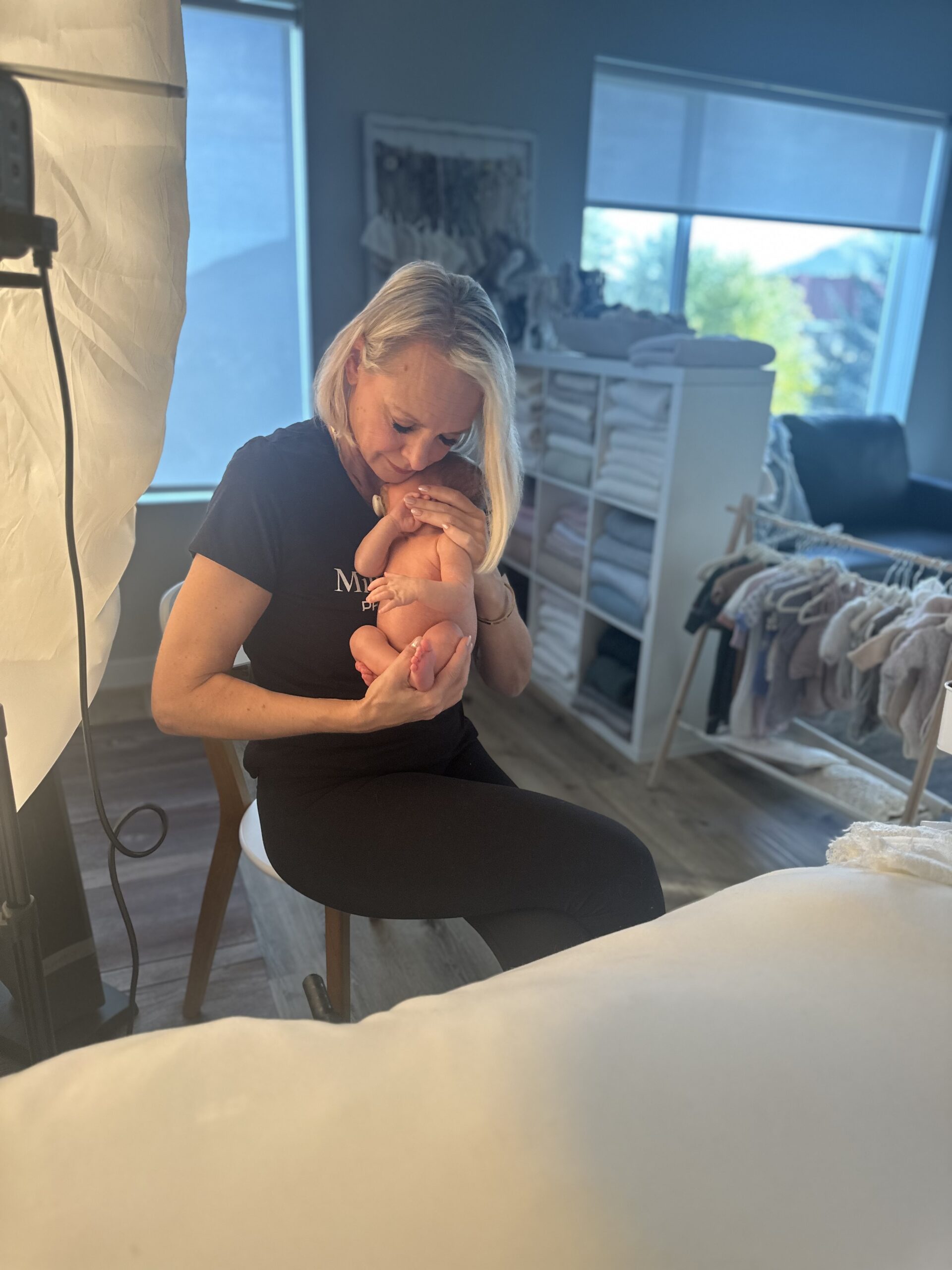
Newborns have a strong startle reflex, and it can happen completely unpredictably. A baby who has been sleeping soundly can suddenly kick and fling their arms with surprising force. I had a baby startle mid-pose once and kick themselves right out of position. In that moment, having a spotter within arm’s reach wasn’t optional, it was the whole reason nothing went wrong.
This is why I always say: never be farther from the baby than you can reach in a second. Always. Even when they seem deeply asleep. Even when everything is going smoothly.
Baby physiology basics
Understanding a little about how newborns are built changes the way you approach posing. Their bones are still largely cartilage and are more flexible than adult bones, which is part of why they can curl into comfortable positions. But that flexibility also means unnatural posing can put real strain on developing structures. A baby’s range of motion is not the same as an adult’s, and a pose that doesn’t look extreme to you might actually be outside of what that specific baby can comfortably do.
Props and what’s actually safe
Not everything you see on Pinterest is safe. Some prop setups that circulate widely online are genuinely dangerous, baskets without stable bases, glass containers, setups that require a baby to balance without support. Prop safety isn’t just about sturdy equipment (though that matters), it’s about understanding that the baby must always be supported and that the setup has to work with the baby’s body, not against it.
The Spotter: Why This Isn’t Optional
I want to spend a moment on spotters because I see this treated as optional, or as something you do “when you have help.” It’s not optional. It’s a standard safety practice.
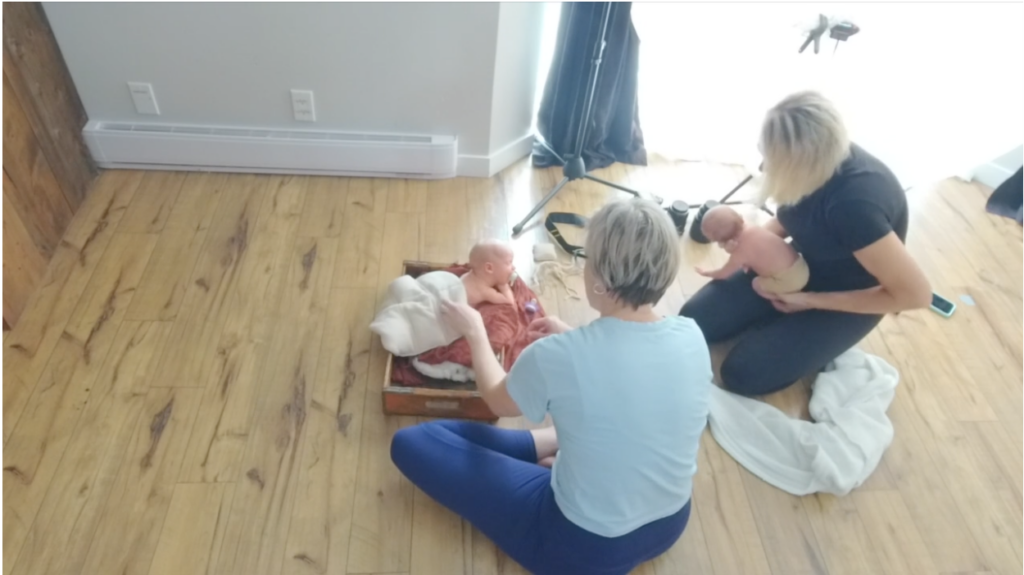
A spotter is another set of eyes and hands, always within arm’s reach of the baby. Their one job is to watch the baby and respond instantly if something shifts. You, as the photographer, cannot always have your hands free. You cannot always see every angle at once. You need someone whose only focus is that baby.
In the early days, I used parents as spotters. That works. As I got more established, having an assistant or a trusted second person made sessions calmer and safer. The investment in that help is worth it every time.
If you are doing a session alone with no spotter, simplify your posing. Stick to setups where the baby is fully supported, wrapped, or held by a parent. This is not a limitation, it’s a professional decision.
Building Trust Without Saying a Word About Safety
Here’s something I’ve noticed over years of working with new parents: the thing that reassures them most is not a speech about your safety protocols.
It’s how you move. How you handle their baby. Whether your hands are steady and confident. Whether you take your time or rush. Whether you read the baby and respond to what they’re telling you, or push through because you want a particular shot.
Parents are watching everything. And what they feel in those first few minutes of a session tells them more than any amount of verbal explanation ever could.
When you’re calm, they’re calm. When you slow down, they relax. When you say “let’s give her a minute, she’s telling us she needs a break,” parents feel that you are listening to their baby, and that matters deeply to them.
The confidence to do all of that comes from actually knowing what you’re doing. Not from faking it, not from hoping for the best, but from having built a foundation of safety knowledge that you can draw on without thinking.
Why Ongoing Learning Matters in This Niche
Safety knowledge in newborn photography isn’t static. Understanding of best practices evolves, information about safe posing techniques gets refined, and things that were widely done ten years ago are now understood to be risky. The photographers who keep learning are the ones who keep improving.
I built the safety curriculum inside Newborn Photography School because when I was starting out, this information was scattered, incomplete, or just not available. I had to piece it together myself, and I made mistakes along the way because I didn’t know what I didn’t know.
The safety module inside NPS covers everything from baby physiology and airway safety to prop safety, temperature, the startle reflex, composites, siblings, legal considerations, and digital safety. Photographers who complete it also receive a safety certification, not because a certificate makes you safe, but because going through the material in depth gives you the knowledge base to make smart decisions in real time.
Because that’s ultimately what safety in newborn photography comes down to. Not a checklist. Not a pose list you’re allowed to do. It’s the ability to walk into any session, read what’s happening, and make the right call, even when it’s inconvenient, even when it’s not the shot you planned, even when a parent is hoping for a particular Pinterest image.
The image is never more important than the child.
If you take nothing else from this post, take that. Because once that becomes your actual standard, not just a phrase you’ve heard but something you genuinely believe and operate from, every decision in a session gets clearer.
FAQ
Do newborn photographers need formal safety training?
There’s no legal requirement for newborn photographers to have safety training, which is part of what makes this industry so variable. But the absence of a requirement doesn’t mean training isn’t necessary. Understanding newborn physiology, airway management, temperature regulation, and posing mechanics directly affects the safety of every baby you work with. Seeking out proper education isn’t optional if you’re going to do this work professionally.
What poses are unsafe for newborns?
The most commonly misunderstood is the froggy pose, where baby appears to rest their head in their hands. This is always a composite (two images merged) and should never be attempted as a single image. Any pose that puts pressure on the baby’s airway, forces unnatural range of motion, or leaves the baby without full support is a risk. If you’re unsure whether a pose is safe, simplify it or skip it.
Have a read through this study on the potential dangers of passive end range positioning during induced sleep in 0–14-day-old neonates
What is a composite pose in newborn photography?
A composite is two or more images combined in editing to create a final photo that couldn’t safely be achieved in a single frame. Many newborn poses that circulate widely online are composites. In one image the hands support the head, in another the body is repositioned. The final result looks seamless. Understanding which poses require compositing is a core part of newborn safety education.
How warm should a newborn photography studio be?
Most newborn photographers keep their studio between 24-27°C (roughly 75-80°F) to help keep baby comfortable and sleepy. Newborns cannot regulate their own body temperature, so the environment has to do some of that work for them. You’re also monitoring throughout the session for signs of overheating, which is just as important as preventing cold.
How do I keep babies safe during a newborn session?
The foundation is: always have a spotter within arm’s reach, never leave baby unattended on a posing surface, understand baby’s airway and how to position the head safely, let the baby lead on posing rather than forcing positions, and build in feeding breaks. Underneath all of that is knowing enough about newborn physiology to make informed decisions in the moment.
Closing
If you’re a beginner photographer and all of this feels like a lot, that’s okay. It is a lot. Every photographer who does this well started exactly where you are.
The difference between photographers who feel confident in their sessions and those who are anxious every time isn’t talent. It’s knowledge. It’s having built a foundation solid enough that when something unexpected happens (and it will), you know what to do.
That’s what safety education gives you. Not a guarantee that nothing will ever go wrong, but the preparation to handle it when something does.
You got into this because you love babies and you want to create something meaningful for families. Invest in the foundation. The rest gets so much easier from there.
If you want to learn more about how I teach newborn safety inside Newborn Photography School here