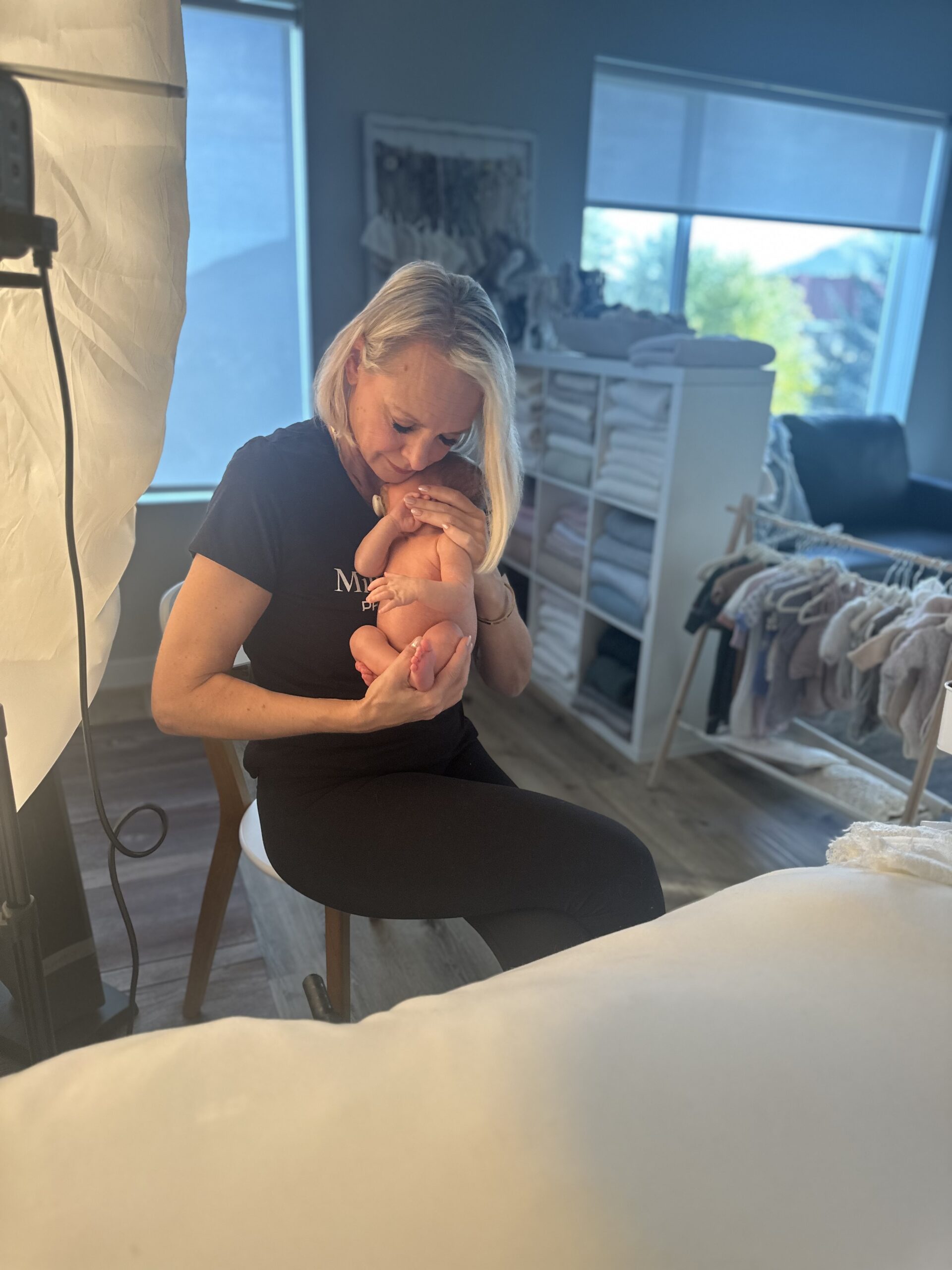
Photographers sometimes assume luxury is reserved for studios, but today’s guest proves that a high-end experience can thrive right inside your clients’ homes.
Chelsea Hickey, the award-winning photographer behind Chicky Little Photography, specializes in in-home newborn storytelling sessions outside of Boston. Averaging $7,000 newborn sales and $4,000 across all genres, she’s built a thriving luxury brand rooted in service, simplicity, and confident systems.

In this conversation, Chelsea shares how she made the leap from burnout-pricing to sustainable profit, why luxury is really about ease and service, and how to confidently guide clients through IPS without feeling “salesy.” She also breaks down money mindset, transparent pricing, outsourcing retouching, and why understanding your cost-of-doing-business will completely change your business.
If you’ve ever dreamed of higher sales, smoother sessions, and a brand that feels elevated without being overwhelming, this episode is a game-changer.
What’s in this episode:
- [02:00] Chelsea’s start in photography and the burnout that forced a pivot
- [04:00] Why she chose in-home newborn sessions over a traditional studio
- [05:00] What luxury actually means (and why service is the foundation)
- [06:00] How she structures her in-home newborn workflow from start to finish
- [08:00] What Chelsea shifted to average $7K newborn sales
- [10:00] Reframing IPS as service, not sales
- [11:00] Overcoming money mindset, and pricing fears
- [13:00] Working less, earning more, and taking 6–7 vacations a year
- [17:00] Paying yourself and the tax lesson that changed everything
- [20:00] Transparent pricing without overwhelming clients
- [23:00] Outsourcing retouching + why “Who Not How” changed her workflow
- [29:00] Gift certificates, portfolio building sessions & how to use them wisely
- [30:00] The first small step toward the luxury market
- [31:00] Chelsea’s courses & resources for photographers
If the luxury world has ever felt like something other photographers could access but not you, Chelsea’s guidance will help you see what’s possible and what you can start shifting right now.
SUBSCRIBE: Apple Podcasts | Spotify
Resources Mentioned
- Denise Duffield-Thomas: Get Rich Lucky B, podcast & books
- Who Not How by Dan Sullivan
- Chelsea’s CODB Calculator (inside her course)
Meet Chelsea Hickey
Chelsea is an award winning, published photographer, and artist whose studio is located just outside of Boston. She lives in Dedham, MA where she is a mother of two young boys and has been taking photos professionally since 2015. With an eye for spotting the little moments that capture personalities and connection, Chelsea’s passion lies in working with young families, capturing authentic moments, creating beautiful artwork and providing an unforgettable experience. In addition to photographing families, Chelsea is also passionate about sharing what she’s learned with others in an accessible, affordable way, allowing new and blooming photographers to gain valuable insights into setting up a successful business.
Winner of AFNS Award, Community Kangaroo: Joey Award, Top 10 Photographer in Pretty Little Poser Magazine, Featured in Inspire Magazine, among others.
Connect with Chelsea
Visit Chelsea’s Website
Follow Chelsea on Instagram
Take Chelsea’s Course
Did this episode with Chelsea help you to see that luxury brand that is profitable and sustainable is possible? Check out this episode Expertly-Crafted Experiences and Top-Tier Service: How to Build a Luxury Photography Brand with Lindsay Walden that shares how another photographer started their career!
Transcript
Chelsea: [00:00:00] So that’s step one. So once you have done all of that work and you have your number, then you’re able to see. How much you need to charge for a session, how many sessions you need to do a month. So this is all very hypothetical. While you’re doing these steps, it’s just coming up with numbers. It’s doing math.
So once you have a clear picture, I think it’s easier to realize that you do have to charge higher. If you want to have. A profitable business, which you do because you have a business that this is what you have to make happen. And then there are strategies once you reach that number, once you figure out that number to lay out your pricing to direct people to that.
[00:01:00]
Lisa: Hello, my beautiful friends. Welcome back to the show Today, I’m excited to welcome Chelsea, the award-winning photographer and artist behind Chicky Little Photography outside of Boston. Since 2015, Chelsea has. Specialized in in-home storytelling sessions for newborns and families creating authentic images filled with connection and joy.
She’s built a thriving luxury brand, averaging $7,000 newborn sales, and 4,000 across all genres, and she’s passionate about helping other photographers do the same. Through her masterclass on bringing documentary family photography into the luxury market, as well as her behind the scenes in-home newborn course and resources on SEO.
IPS and Luxury Services. Chelsea is showing photographers what’s possible when you combine artistry with confident business [00:02:00] practices. Welcome, Chelsea.
Chelsea: Hi. Thank you so.
Lisa: Well, you started your business back in 2015, so can you share a little bit about the early days and how you’ve evolved since then?
Chelsea: Yeah, I started my business I think a lot like, , other photographers, especially women, did with taking pictures of their own children. And I had a background in art, so I picked up my camera again and started back up with that and started taking pictures of them. And then it very quickly developed into me taking pictures of our friend’s, children and all that.
And then I thought, why don’t I make a business? And I did. And, as most people struggle to do, I had a hard time with pricing and I priced myself very low, which made me very busy, and I very quickly realized that there was going to be a big problem with burnout and time. So that’s where I decided I needed to make some changes.
Lisa: I love that. I think that’s. Like most of our story that we, you know, we start low and then we get busy and then we just can’t keep up and we’re just like, oh my gosh, I can’t, I feel like [00:03:00] Walmart this is not how I want to feel in my life or my business. So at what point did you really realize you wanted to move beyond just being a photographer and really start building that luxury brand?
Chelsea: Well, it was right around that timeframe where I realized that I was giving up my weekends with my kids to do these shoots and that I really wasn’t making a whole lot of money in the grand scheme of things, and my own costs were starting to add up and as in terms of running my own business. And that’s when I decided that I needed To really take a look at things closely and make some changes. And in order to do that, rather than just winging it and trying to reinvent the wheel, what really worked for me was figuring out education and what was going to help me best and seeking out different coaches and then trying out different methods and figuring it out from there.
Lisa: I think we get so hung up on when it comes to luxury and we think, okay, well maybe I have a home studio, or maybe I’m on location, like how can I be luxury when I don’t feel luxury? So can you maybe [00:04:00] share a little bit about luxury and what that means to you and how you’ve translated that into like in-home sessions.
Chelsea: Absolutely. So, just to back up a little bit, what I found when I started investing in education and working with coaches was that a lot of the direction they were giving and the education they were providing was focused on portrait based studios. So having people come into your studio and providing this great service for them and then selling wall art and that was the luxury model.
And I found that because I specialize in, in-home newborns, that it took a little bit of tweaking to their models and what they were teaching in order to make it work for me. So that’s sort of where I landed in the end. But when it comes to luxury, the foundation is really about service and serving your clients.
For me, with the in-home newborn sessions, it’s really about making the session as easy and streamlined for the parents as possible because they have this new baby and they really don’t wanna be thinking about a photography session. So when you look at a traditional. [00:05:00] Studio session, you think about, you know, the parents having to bring in the baby within the 10 day mark and get everything to the studio and have the outfits ready, and then sitter.
I did the same thing when I had my baby. I went into a studio session and the pictures were great, but I remember sitting on a couch pretty much half asleep. You know, like, why, why am I here? What’s going on? So I really focus on bringing everything to them and keeping them.
informed throughout the entire process so that they don’t have any homework, they know what to expect. I’ve helped them pick out outfits. I’ve helped them, decide the shots we were gonna get. And then I come into their home and we do everything there. So really, the service end of it is what makes it luxury.
I also do IPS and things like that. So I’m selling to them in person, but for even for that, I’m coming back to their home for it because I don’t want them to have to load up new baby and travel to my studio to do that as well. So as easy as I can make it for them, that’s what they’re paying for.
Lisa: I love that. It’s funny that we’re having this conversation because after 15 years as a newborn photographer in my own studio and [00:06:00] I’ve had like commercial locations, right now, the street, like we live on a main road and it is gonna be like torn up for about four or five months. And so every day it’s an adventure on how to get into my house.
Like things are dug up, sometimes I can’t get in. And so I was like, okay, well I have to adapt my business now, so I will be going on location as opposed newborn photographer for my next three or four or five newborn sessions. So I’m really excited because I’ve always said, I’m never doing on location.
Never. And I’m like, but why? But why?
Chelsea: because I think that when it comes to luxury, a lot of people default to, if I don’t have a studio and if I’m just showing up at somebody’s house, that the perception is that I’m not really a professional because I don’t have my own space. And I think it’s the opposite because going back to the service end of it, you really are providing this luxury service.
You know, compared to, getting a closet system installed in your house or something, custom done in your home, that [00:07:00] person comes to you, they bring the samples, everything is done for you while you’re there and everything’s installed for you. You don’t have to go anywhere. You don’t have to lift a finger.
It’s very similar to that experience. And that’s essentially what you can charge for, what they’re paying for and what they value.
Lisa: Yeah, I love that ’cause it’s two of my favorite clients. One’s having her fourth and one is having her second, but had a really, really rough delivery. And I just was like, how about I come to you? And it was just really funny how this is like, I’d never thought that this could be possible for me and like how much I actually.
Use in my session is really not that much
Chelsea: That’s right. And once you do it, you know, and get your systems down, then it really isn’t that much. You kind of figure out what works for you and what works for your clients, and it doesn’t have to be an over the top ordeal. It’s just really about making it easy.
Lisa: Love that. Love that. So you average seven K newborn sales and 4K across other genres. So those numbers are [00:08:00] awesome. So what shifted in your business that helps you achieve those numbers?
Chelsea: So it was really, like I said, coming into this luxury model. So the first step was really nailing down the service end of it. You know what were clients going to value, understanding that this is not for everyone, that you’re not going to be. Booking every call you get at this price range. But the people that do book are the best clients.
You know, they value what you do, they’re willing to pay. They love everything. They’re great to work with. So that in itself is worth it. But, the elements of the service that are included go all the way down to helping them through the entire process from start to finish. So not only are you making the shoot streamlined, but you’re making the preliminary portion streamlined the planning portion of the session.
I go to each of my clients’ homes before the session I walk. Through their rooms with them. We really nail down the shot list. We talk about what rooms we’re gonna shoot in. We pick out colors for the baby. I help them with their wardrobe. I go through their closets [00:09:00] with them. I make sure that when I come in, it’s usually about a week before the shoot that I do this.
I to make sure that when I come in, everybody’s just ready to go so that they don’t have to think about this the day of. I also provide in-home hair and makeup. So that comes to the house before. So I’ll usually have the makeup artist come first and then I’ll get started with the detail shots of the baby while they’re doing that.
And then we kind of go from there. So those things in itself, that’s gonna make mom feel her best and look her best in the pictures and therefore buy more, hopefully. And then at the other end of it, once the session is done, I don’t just send them a gallery to figure out on their own. We have an IPS ordering appointment, like I mentioned, so they don’t need to come to the studio for that.
I go back to them and then we go through all the pictures together. I help them choose everything. I show them mockups on their walls so they can see if they wanna put things up, what size they need it in. And then when they’re done with that, I get everything ordered. And once it’s in, I bring it back over.
If they have wall art, I even install the wall art. So it’s really a start to finish experience. Selling that to them, knowing [00:10:00] that they really don’t have to do anything is the most valuable piece of it.
Lisa: Now most photographers are really uncomfortable with sales and money that. Probably one of the biggest hangups that we hear from our students is that I’d love to do IPS or in person sales, or even after sales from the shoot, but it’s getting over that hump that my clients won’t pay that, or I can’t find clients that will.
So what thoughts do you have around that?
Chelsea: Well, I had all of those same thoughts and I struggled with it for quite a bit and I really had to do a lot of mindset work to wrap my head around this. And I can recommend books and things that I read for those, but it really is about understanding first off your own relationship with money and how you think about things and what you value, and then sort of. Also realizing that that’s not the same for everyone. So I myself would not spend $7,000 on newborn pictures, but the people who do [00:11:00] really value it, and like I said, they really value this experience. So it’s putting myself in the kind of open-minded position that I can see that they are going to value all of these things.
Money, mindset is the other thing is really just , getting a handle on that.
Lisa: Okay, so money mindset. What books would you recommend?
Chelsea: I started off with Denise Duffield Thomas. She wrote Get Rich, rich, lucky Bee, and all of those books, and I found her to be very eye-opening. She brings everything down to your own relationship with money, how you were raised, how, whether you were from money or not from money. The things you value, the things you don’t, the things you’re scared of spending it on, and all of these things.
And it’s just a really good introspective way to examine yourself and get a handle on the fact that just because you might not. Agree or see what other people see doesn’t mean that that’s the truth for everyone. So getting past that is step one. Start with her. Listen to her podcast, read her books. Audio books are [00:12:00] great.
Lisa: I love it. I actually had Denise on the show and I actually went to we had a business retreat that we were on with her, and so I
got to
Chelsea: I.
Lisa: some time with her. Yeah.
Awesome.
Chelsea: did too. And then there was like a luncheon, like a brunch with her, and she was amazing. I
loved her. Yeah,
Lisa: Yeah, so good. I love it. She’s like, I’m like, can you please just come to Canada?
Chelsea: yeah. I know. I just, she’s great. She really is. And she’s so down to earth and like used, approachable and everything else. But I just love her, her methods and her theories and the way that she, she lives her life. It’s amazing.
Lisa: yeah. And just like even the anti hussle culture, like business can be simple and lucrative.
Chelsea: And that’s actually another part of, when you look at the the amount of effort that goes into the sessions that I’m describing, it’s can sound overwhelming. Because there are all these steps. You essentially have five or six touch points with your client throughout the process, and that takes a lot of time.
But when you come [00:13:00] down to the averages, and I’m averaging 7,000 for the newborns, I only need two or three of those a month. So when I block off my calendar, I am accounting for all of those meetings and everything, which does fill my calendar. But in terms of sessions. It’s very few, and so that work life balance is really there.
Last year I took like six or seven vacations and, you know, it felt like I was never working, but I, I also made quite a bit of money, which was great.
Lisa: I love that. I love that. I think that, it’s funny ’cause there is that kind of block that a lot of students, and sometimes, and to be honest, I think I have that too is that we live in areas that there aren’t those people. Those people just don’t exist. I live super rural and we’re in a small town or like, so what would you say to those people that sort of have that block?
Chelsea: So I think that if you really look around, you would see that those people are there. And the best way to do that is to drive around and kind of see like what kind of cars are around. You know, is there a section of town where there are higher end cars and higher end possessions? Because [00:14:00] those will narrow down the niches.
Usually you’ll find, and I know that there are very small towns where there isn’t a lot of money, but typically within an hour radius. You can find those people. So if you’re, again, willing to put in the time and effort, if you have to drive to someone, it’s not that big a deal. You just need to account for your time and your marketing.
So, I would say if it is a little bit of a distance, then find networking events and things that are, in those areas and push your marketing to those areas rather than just in your community. And it’s absolutely possible to find.
Lisa: So what advice would you have to someone who’s just really resistant on raising those prices?
Chelsea: Well, the first thing you need to do and any business owner needs to do is run your cost of doing business. Because once you lay out all of your numbers and you see where all of your money is going, you get a very clear picture of what you are going to need to make in order to be profitable.
So that’s step one. So once you have done all of that work and you have your number, [00:15:00] then you’re able to see. How much you need to charge for a session, how many sessions you need to do a month. So this is all very hypothetical. While you’re doing these steps, it’s just coming up with numbers. It’s doing math.
So once you have a clear picture, I think it’s easier to realize that you do have to charge higher. If you want to have. A profitable business, which you do because you have a business that this is what you have to make happen. And then there are strategies once you reach that number, once you figure out that number to lay out your pricing to direct people to that.
One number you want. And I do have actually, in my course, there’s a cost of doing business calculator that makes this really easy. So what you basically do is a spreadsheet you put all of your numbers in and it has a automatic calculator that tells you how many sessions you need to do and what your average needs to be so that you can very easily get that number, and then you can figure out how you’re going to direct your clients to hit that
Lisa: for the first number of years I kind of got stuck in. [00:16:00] I didn’t realize I had to pay myself and I would take all the money that I would earn and I would. Spend it on props and blankets and headbands and all the things. And I think that’s a huge trap that so many photographers get into, especially if they have a spouse that has the main income of the family which I did at that time.
So, what advice do you have for that when they’re just not even realizing that they have to get
pay themselves?
Chelsea: You know, I fell into that same trap I just actually had a very, very high tax bill last year for the first time ever because it was the most I’d ever earned. And it was a big stressor and it actually really affected my money mindset, having this kind of weight hanging over me of not knowing how much it was gonna be and not having kept enough track of all of those numbers it really affected the rest of my year, you know, in the end waiting, waiting around to see how much I was going to have. So I think that it’s just all part of financial planning. Some people are better at it than others. [00:17:00] I, for myself, basically, now that I have things a little bit more in, when it comes to the tax portion of it.
Just uh, take like quarterly chunks out. So once I pay my taxes, I see how much is left, and then I’ll pay myself in those chunks and put it away or whatever we’re going to do with it. But there’s, I mean, obviously tons of different systems, but it is really important to remember that, that you are doing this so that you can earn a living and not, not just buy new props, buy
some props, but
Lisa: exactly. Exactly right. I know you can have a hobby business, but if you’re gonna have a business, business run Right. Okay. You built resources around SEO. IPS, and Luxury Services. Why do you think these are so important for photographers
Chelsea: they’re all parts of the service of the luxury service. SEO obviously is important for marketing, so you wanna make sure you have a good strategy within your website that’s gonna be targeting the right people. If you do have those affluent areas around you, you wanna be focused on those. You wanna be focused on the fact that you’re service-based beyond [00:18:00] just providing photographs so that people can kind of.
See that there’s a difference, and you do want them to see that when they hit your page because as soon as they’re going to your website, you don’t necessarily wanna deter them with really high numbers and scary things, but you want them to understand that this is probably a little bit more elevated than some of the other photographers that they might have looked at.
So that if they do proceed with booking a call with you, they’re not totally shocked. They, you know that, that this is more than they thought it was going to be. So that’s the one way I pre-qualify. And a lot of that is through SEO. IPS is important because that’s where your sales are. So I’ve tried to just break down very simply that it’s not scary, it’s serving your clients.
So if you change that word from in-person sales to serving, then you’re going to. Quickly wrap your head around the fact that this is a service for your, clients. It’s not forcing them to do something. It’s not annoying for them. It’s helping them through the process. and luxury services. Well, that was all we kind of talked about earlier too, is just that you need all of the service end of [00:19:00] everything in order to have a luxury brand, because that is essentially what they’re paying for. There’s so everybody’s a photo photographer, right?
So it’s, you have to, you have to define why you’re different and what you’re going to do for them, and how you’re gonna make their life easier with this
process.
Lisa: One thing I often hear, like from other clients or, you know, people who have had experiences sometimes with IPS, photographers is not being transparent or clear about the process. So there ends up feeling like this bait and switch where it’s like $200. Session fee, and they didn’t really know that they’re purchasing things on the backend.
So how do you get around that? Or just make sure things are so unbelievably clear that everybody knows everything. And especially the
spouses too.
Chelsea: Mm-hmm. That’s a good question. So there is psychology involved in the pricing because people are going to bulk if you tell them that this is going to cost ’em $7,000. So there are strategies in place when I am talking to a client that I [00:20:00] use, but I’m at the same time, I am transparent. So. What I do is I use my website to pre-qualify my clients.
So when they’re looking at the website, like I said, it should scream, this is luxury. This is probably going to be expensive. But there isn’t pricing on my website. They have to book a call with me. So once they book a call, that’s when we go through everything. So I will explain all of the services that are included.
I will listen. The first part is gonna be listening to exactly what they want, because a huge part of the service is making sure that this is customized to what they want and that we’re solving all of their problems. So, you know, depending on what is valuable to them, what they’re concerned about, I wanna reassure I’m there for them. , That’s the first part of the call. And then the second part is presenting the services that I will be offering them. And how they can take advantage of them. And the third part is breaking down the pricing. So. There’s so many different ways that people can go about pricing , and the things in the methods that I’m teaching with my course.
I don’t really dive into the specifics of it, [00:21:00] but I do go over kind of different strategies that you can use. But essentially what I do is I give them a range of what they could be, what most people will be spending, and then after the phone call, when I send them all of the follow-up materials, that’s just kind of recaps the phone call.
I do include a price list with that, so at that point they do see it. Whether they look at it or not is, you know, up in the air, because some people don’t. When I go to the consultation, the part where I go into their house look through everything together, , I bring the price list with me there and I sit down with them and go through it.
You know, next to them to make sure that they see all the numbers so that when it comes to the ordering appointment, there’s no scary surprises. So I really make sure that everybody is as informed as possible because the worst thing ever is getting to the ordering appointment. And especially if the husband has sort of been like off in the distance through all this, it’s very uncomfortable if he was not aware.
So doing it is important to be transparent for sure.
Lisa: I agree. That’s the one thing I hear is [00:22:00] that, when they don’t have both. people that are making decisions about their finances, as a family, that is the biggest thing. It’s either like, I gotta go check with my husband, or like, and then the nothing happens, the sales don’t happen.
So having everybody like pre-qualified,
I think is so, so,
important
Chelsea: Exactly though all of those preemptive steps you can do at that consultation. If you can try to have both parents there, you know, any way that you can make sure that all the decision makers are a part of, at least a part of the process where, especially where pricing has been, there’s been a conversation about it, that’s gonna make the IPS appointments so much easier when everyone’s on the same page and, and knows what’s going on,
Lisa: Yeah, I love that. Now, I also noticed that you, outsource your retouching. So can you share about that and , how it’s important to build that in your pricing structure too,
if that’s
something that you’re interested in doing?
Chelsea: So this is a very touchy point for a lot of photographers, and I was one of them. , Because like I, I went to art [00:23:00] school. I was an artist. I am an artist and that’s a huge making a photograph my own. But I got to a point where when it kept coming up that I should be doing this and I was so resistant, I sat down and analyzed what exactly I was doing with my photographs, especially when it comes to volume work.
So the newborn sessions. I mean, I’m using that as an example because that’s my highest average, but they are coming down to volume. The reason that those sales are so high are because there’s so much variety in what we’re shooting at those sessions that they buy a lot. So when it comes to editing those pictures, . I do a two step process, so I do soft edits on them, and that’s what I show them at the IPS appointment. And then anything they purchase, I’ll go back in and retouch. So if there’s, you know, skin issues on the baby or anything like that, it only happens on the purchased images and the clients do know that.
But for that, especially that soft edit portion of it, I realized that I was really doing the same, you know, three or four clicks of the same. It was very, very mechanical, very monotonous. And there was no reason why I [00:24:00] couldn’t teach someone to do that. So I found a retoucher. It took very little training.
There was a little bit of back and forth on getting things right, but once it was sorted out, it’s like the best feeling ever to come home from a session and just send everything off. And then have it come back ready to go for the appointment. And I will say I still do my own retouching on certain images.
I do like fine art photography, things like that. You know, things that are, are really creative and are mine, I will do. But when it comes to that bulk stuff that just needs to get off my plate, I I 100% support for sending out your Do Recher. that’s another book that really helped was, who Not How By Dan Sullivan.
it’s all about, focusing on your zone of genius. And the thing that only you can do yeah. Is, is yours and then someone else should be doing everything else. And that
way you get that work
life balance.
Lisa: I know my, listeners’ gonna be the next question is how do you find a retouch that vibes with you?
Chelsea: It’s tricky. there are tons of Facebook groups that are retouching, , groups, so that’s a [00:25:00] good place to start. I went through a couple of ’em and there are different ones that I use. For, say, studio work versus the newborn work? So the girl that I used for the newborn work, she’s been the same girl that I’ve used for a couple years now, and that was just kind of trial and error.
Finding somebody that understood the presets I was using and, you know, was, already working with things like that. The retouchers for the studio sessions are often like in the Philippines and things like that, and they’re everywhere. If you even post the word retouch on anything, they’ll start emailing you. So probably most people have already been contacted by retouchers, honestly. But it’s just kind of trial and error. A lot of times they will give you a trial thing so you can send them several images and see how they do, and. If you’re willing to do back and forth with them, they’ll tweak things.
So it’s not hard to find someone, it’s more your price point, and you do just have to work that into your
costs as well.
Lisa: so I know like I am an overs shooter from way back and also an overdeliver. So [00:26:00] when it comes to retouching, you kind of have to reel it in because usually you’re paying per image
Chelsea: exactly. Exactly.
for me, it’s worked out well with the girl that I use for the newborns because she also does culling. So that took a little bit longer training wise to teach her what I would pick. , And it took a lot of back and forth on things like that. But now that she’s trained, I send her everything.
So she. To the number that I’m trying to hit roughly. And then she only retouches those, and again, this is the soft retouching she’s doing on these. So it is a lot of photos, but it’s taking her very little time per image. So the cost isn’t that high when they other retouchers do like the studio work and they’re really going in and, fixing up, you know, although AI can do most of this now too, but they spend a little bit more time and they charge a little bit more for those.
So I’m kind of more careful about what I’m sending on those. And a lot of times when we’re doing studio work, we don’t do any retouching well before the, photos are chosen anyway. They choose straight outta camera and then only the purchased images
get retouched.
Lisa: I love it. So what is your turnaround time [00:27:00] between the session and the I guess the
picking and then
delivering?
Chelsea: so for the newborn sessions, about two weeks. So I usually give myself the two week leeway. Typically, I’ll be done sooner than that. Like I said, I’m only shooting three of these a month, so I’m not swamped with work, and I make sure usually at the session when I’m done, we’ll pick the date for the ordering appointment.
So I try to put it about two weeks out. And then as soon as I get home, I send everything off and it takes them a couple days to send it back. And then I’m sitting there ready for the appointment. Aside from, some of the mockups and things like that, it’s
pretty easy.
Lisa: I love that. Three sessions a month sounds pretty blissful
actually.
Chelsea: pretty nice. The tricky part is booking them though.
Lisa: Right, right.
Chelsea: There’s a lot of knows in there.
Lisa: I love it. So when it comes to marketing with luxury market, what is your. Best marketing tricks and
tips.
Chelsea: if we’re talking about newborns, it’s very different than any other genre. So if we’re focused on newborns, honestly, Google has been my friend, Yeah. Google Ads in my SEO has been where the majority of my clients come from, and [00:28:00] I think that’s because of that pre-qualifying factor through the website.
Anybody who’s driven to the website understands what they’re getting into. I do go to networking events. I go to parent events, I have kids as well. I have a lot of repeat clients and things like that, but for newborns specifically, that’s really been the most effective strategy when it comes to studio work, especially headshots and branding and things that are a little bit on, more on the professional end.
Networking events are fantastic, you know, that’s where I meet a lot of people, talk to a lot of people, run promotions and things like that and get them in there. But, different strategies for
different genres, I would say.
Lisa: Yeah. where are you with gift certificates? Because a gift certificate client is so different than a client who’s been like looking at your work, saving up for years because they really wanna work with you.
So what’s your stance on that?
Chelsea: So for gift certificates, I am strategic about who I give them to. So it might be a business that I wanna partner with, or someone who’s affluent in the community, or someone [00:29:00] who has a big mouth and likes to talk to everyone. You know, I’m really strategic about. Who they are and giving them the full experience so that when they’re talking to other people, they know what exactly I’m offering.
You don’t wanna just give them a gift certificate and give them kind of a half experience because it was free. You still wanna give them everything. And I don’t do it very often. more typically when I’m slow, we’ll do a portfolio building session. And I don’t call it a model call because people tend to just assume that’s a free shoot.
I call it a portfolio building session. And I will usually just tell them how many images are gonna be included in it for them and that they’re welcome to buy more. And I actually, in the winter when I was. Slow. I averaged 2000 with, three or four model call sessions, so it worked out really well.
And then I got portfolio images as well. So, that’s a strategy, especially if you are slow or if you just wanna play with something new. And people are always willing to get something free and sometimes they’ll buy more.
Lisa: So photographers who are listening, who are dreaming of [00:30:00] those higher sales, but they’re really feeling stuck. What’s one step that they can take today to start moving
towards the luxury market?
Chelsea: I think that if you haven’t done it already, this running, your cost of doing business is the first step. You can’t do anything or know enough until you run those numbers and you get , that one number that you need know what, how you’re gonna move forward. . I think that’s the most important part.
And then the rest down to pricing strategy and, , what you wanna offer in
terms of service.
Lisa: I love that. you’re moving into education, so tell us a little bit what you’re offering and
where people can find you.
Chelsea: Yeah. So I’ve designed a master course for newborn photographers. Specifically, it can be adapted to things like family, but it really isn’t about studio work. So if you’re looking for how to break into the luxury market.
In newborn or family on location type photography, then it works really well and it basically just goes more in depth to the things that we talked about in terms of [00:31:00] pre-qualifying clients, IPS, the services you can offer and creating that luxury experience and, running your cost of doing business.
Like I said, it has that calculator in there, so it kind of gives you a foundation to get going with this. I’ve priced it reasonably, just because I think that it’s information that helps everyone. And I also think that industry standard wise, we all kind of need to elevate so that we can create those, standards that the clients need as well to know what what to expect. I also have a sort of an IPS mini course that just goes over the general steps of IPS and gets you more comfortable with what to expect and how to set up your IPS appointments. And I do have a phone script as well that you can download that helps with the newborn photography if you’re trying to talk to your clients on the phone. And there’s a couple different mini things in there as well. They’re on the Etsy shop and the main course, I think is linked, here to go ahead , and grab that as well. But you can read more about it
on the page there.
Lisa: Perfect. I love it. So I wanna switch gears a little [00:32:00] bit. So what brings you joy right now outside of photo?
Chelsea: now. Oh, I don’t know. We’re talking about buying a vacation home. We’re talking about maybe moving, we’re like all over the place or all these things, but we’re pretty fortunate. We travel a lot, so we did a lot of traveling this summer. And I’m just sort of right now getting back into the swing of things and focusing on photography.
I moved into a new studio space. I’m shifting some things around, so I have a lot going on in my brain. The kids being back in school brings me
joy.
Lisa: Yeah. How old are your kids?
Chelsea: They
are eight and 11.
Lisa: I love it. So what’s the last photo you took
for just yourself?
Chelsea: Actually it was with my boys. So we were just on Cape Cod, , last week and it’s been ages since I brought my real camera, you know, to a location and lighting and did the whole thing. And it happened. All the stars aligned and everybody was in a good mood. And I got some really nice beach pictures of the boys. So that was, nice. I always have all these beautiful pictures of everyone
else’s children and just phone pictures of my own.
Lisa: I know. I know. Same. my [00:33:00] son, is gonna be 16 and. I don’t really get much of him
anymore.
Chelsea: I know.
Lisa: Usually there’s a middle finger somewhere in
there.
Chelsea: Yeah. Yeah. Rolling eyes walking away.
Lisa: Yeah.
Chelsea: Yeah.
Lisa: I love it. So where can our listeners find
you online?
Chelsea: So that’s a funny question as well. I am rebranding currently. My website is chicky little photography.com. It’s going to be shifting to chelsea hickey photography.com. but hopefully all my redirects and everything will work on there. There is a link here to the course itself, but there’s also a landing page on chicky little photography.com.
If you go to for photographers, there’s a section there and you can click on that, and that will go to all the other courses that I have available as well. So you can
kind of
explore and see
what
Lisa: that. Perfect. So I love to end my interviews just with this last question, and it is, what are you currently curious about or artistically curious about?
Chelsea: So I, again, coming from a fine art background, I majored in oil painting, which is not the most [00:34:00] lucrative major, but, I love fine art photography and I have been practicing it since I started photography again, but I haven’t figured out a way to market it very well. So that’s kind of my hope is that I can now with this new studio space Break into that market a little bit and really push for these like very artistic shoots
that are painterly
and
well
Lisa: I love it. Have you
tried digital painting at all?
Chelsea: I’ve done tons of it. I love it. I love all of it. I used to do all the composites and everything with the kids in different, started with that. But I just love, the look of, you know, dramatic light
and the painterly style and all of that.
So hopefully we’ll
get to play with some of that.
Lisa: I love it. Well, Chelsea, thank you So
much for joining me
today,
Chelsea: So welcome. Thank you for having me.
Lisa: Oh my beautiful friends. I hope you have loved this interview just as much as I have. I’m sending you so much of my light and my love today and every single day. We’ll see you next time.
[00:35:00]